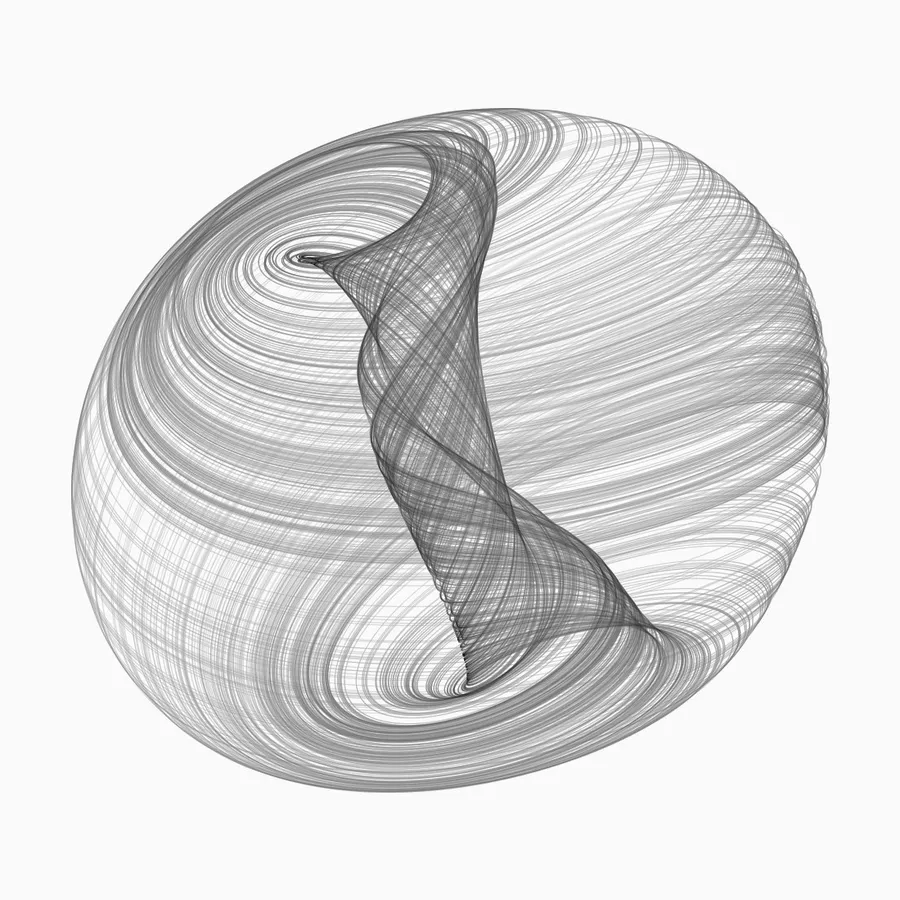
A sphere pierced by a tube.
The Aizawa attractor, also known as the Langford attractor, is a system of three ordinary differential equations that produces one of the most sculptural shapes in the chaotic zoo.
Trajectories wrap around the surface of a sphere-like body, then dive through a twisted tube along its axis and emerge on the other side, again and again, never repeating the same path.
Unlike the butterfly-like Lorenz family, the Aizawa attractor needs six parameters to keep its form. Small changes to e or f are enough to tear the sphere open or collapse the inner tube.
The algorithm
javascript·aizawa-attractor.js
const a = 0.95;
const b = 0.7;
const c = 0.6;
const d = 3.5;
const e = 0.25;
const f = 0.1;

const next = (x,y,z) => {
  const dx = (z - b) * x - d * y;
  const dy = d * x + (z - b) * y;
  const dz = c + a * z - Math.pow(z, 3) / 3 - (x * x + y * y) * (1 + e * z) + f * z * Math.pow(x, 3);
  return {dx,dy,dz};
};
The system is quite stiff around the tube, so a smaller time step (dt = 0.005) or a Runge–Kutta integrator keeps the surface smooth.
References